
Staging a Moral Dilemma: When Broadway Asks ‘What Would You Do?’
Updated: Jan 28
—
From Hairspray to Cabaret, how musical theatre tackles life’s toughest questions of ethics, politics, and justice.

The state of the world is troubling right now, and it feels like unprecedented times. But many of these events closely resemble hardships that society has been through before.
It would be easier if life was simply a cabaret—but art reflects reality, which is anything but simple. The constant inundation of polarizing chaos in our world today is unsettling to say the least. It’s hard to keep up, and with every new crisis, we’re faced with a series of choices:
Am I concerned or do I check out of this conversation?
Which ‘side’ of the issue am I on, or do I have a more neutral stance?
If I engage, what and how should I execute my involvement?
Of course, these questions don’t always have simple answers. It helps to have mentally run through similar scenarios in the past, which can help process new issues, and make you more prepared for the ultimate question:
“What would you do?”
Here are 7 musicals that ask that, in various ways.

Parade
Where will you stand when the flood comes?
Book: Alfred Uhry | Music and Lyrics: Jason Robert Brow
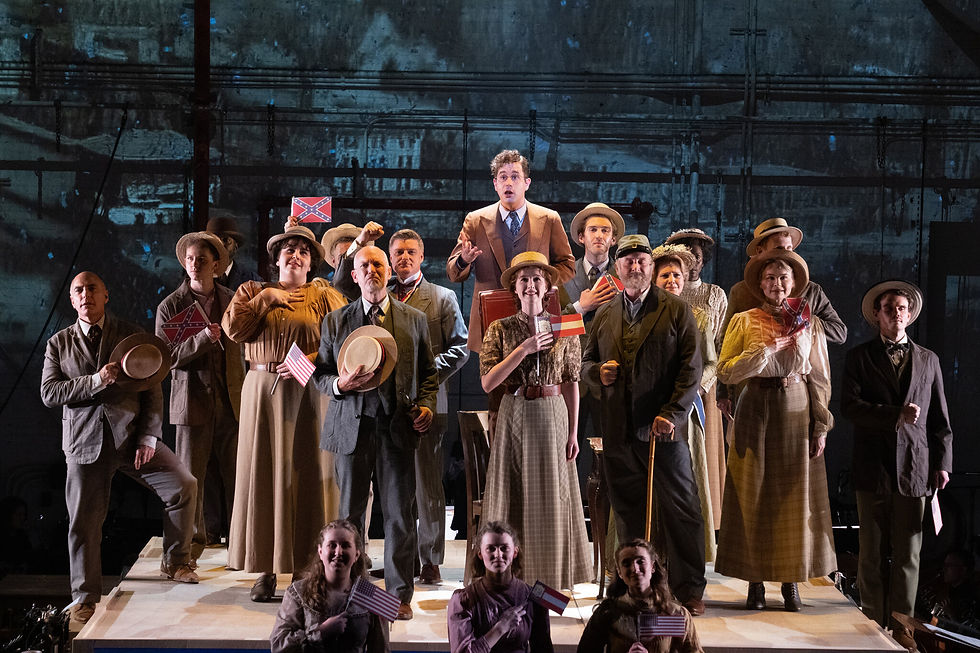
This dark musical chronicles the real-life story of Leo Frank, a Jewish man who was wrongfully convicted and lynched in the early 20th century. It premiered on Broadway in 1998 and was revived in 2023 starring Ben Platt and later Jeremy Jordan, two Jewish actors known for emotionally raw performances about grief.
In Parade, Leo Frank is the manager of a factory who employs a young girl who becomes the initial victim of the story. Mary Phagan, originally played by Kim Possible's Christy Carlson Romano, is tragically molested and murdered at the factory.
The finger is immediately pointed at Frank—the target of antisemitism, scapegoatism, and tabloid sensationalism. Local authorities abuse power and status to get bystanders to play into this narrative, which was inflated by reporters for their own career gains.
How it’s relevant today
We see so much of these back-scatching tactics today between those who have selfish agendas with skeletons to hide, and the powerless looking to ride on the backs of the powerful, no matter the moral implications. Many jump to conclusions based on very little, often unreliable, information, at the expense of often innocent victims. Plus it goes without saying that minorities continue to be under attack in the U.S. and worldwide.
➜ How much do we personally investigate controversy, rather than going off of hearsay?

Urinetown
It’s a privilege to pee
Book: Greg Kotis | Music: Mark Hollmann; lyrics by Kotis and Hollmann
Urinetown satirically draws attention to issues like environmental crisis, political corruption, classism, and societal division. The show broke into the mainstream after winning multiple Tony Awards, and has since become a cult favourite among fans of political satire and dystopian stories like The Hunger Games and Don’t Look Up.
The inciting scenario is a water shortage in a fictional American town, which leads to the
monopolization of toilets by a megacorporation. Gotta pee? Gotta pay. Is the title Urinetown making sense now?
A rebellion is led by a lowly employee who is in love with the daughter of the president of
UGC (Urine Good Company), and things get...slippery. To balance the very relatable conflicts presented, the writers use parody and farce—often breaking the fourth wall to bring the audience in on jokes.

What it really means
This story illustrates how our responses to political issues aren’t always black and white.
When there are jobs, relationships, and basic biological needs in play, our decision-making process can become gray (water). Where do we draw the line between our ethics and survival tactics?
➜ Where do we draw the line between our ethics and survival tactics?

Assassins
Another national anthem
Book: John Weidman | Music and lyrics: Stephen Sondheim
Originally conceived by Charles Gilbert Jr., Assassins is an episodic musical that peels back the curtain on the motives and actions of individuals who attempted to assassinate U.S.presidents, successfully or not.
With the surge of true-crime cinema and heightened political tension today, the show feels as timely now as when it debuted Off-Broadway in 1990. It was later revived on Broadway in 2004, and Off-Broadway in 2021.
This revue, based on true events, unfolds within an artillery-carnival game structure, presented as a series of standalone vignettes. Some of the figures depicted are Abraham Lincoln and John F. Kennedy, as well as their respective assassins John Wilkes Booth and Lee Harvey Oswald. The character of The Balladeer (played by Neil Patrick Harris in the revival) represents the American Dream and connects the segments through sung narration.

Analysis vs. condonation
Assassins zooms in on each offender’s and victim’s individual story. It doesn’t impose a moral code or justify anyone’s actions, but instead examines the complexity of these historical figures—why and how they took the actions they did.
It’s heavy subject matter, but few mediums make it as digestible as the disarming energy of musical theatre.
➜ Why are we fascinated with true crime stories and what can we learn from them?

Hairspray
Welcome to the 60’s
Book: Mark O'Donnell and Thomas Meehan | Music: Marc Shaiman; lyrics by Shaiman and Scott Wittman
In 1988, John Waters created a campy yet political film starring Rikki Lake, drag queen Divine, and Debbie Harry (Blondie). It was later adapted into a stage musical, and then a Hollywood blockbuster starring John Travolta, Zac Efron, Queen Latifah, and Michelle Pfeiffer.
Hairspray follows aspirational teen Tracy Turnblad in early 1960’s Baltimore as she vies for a spot on televised The Corny Collins Show. Along the way, she confronts two major forms of discrimination from both TV executives and the public:
Fatphobia (Tracy is full-figured with big, bold hair)
Racism, standing in solidarity with her Black peers (Jim Crow laws are still in effect)
With the help of a progressive record shop owner, Tracy and peers successfully protest segregation culture, and The Corny Collins Show becomes a pioneer for integration and inclusivity.

The groovy message remains
Though depicted through danceable music and vibrant costumes, Hairspray remains a pointed reminder of how things were—and how they often still are—proving pop culture has a real place in the fight for social justice.
➜ Is it better to wait until you have your foot in the door before calling out injustices?
Theatre is meant to be thought-provoking—it allows us to see issues from new perspectives and helps us process the world around us.

Dear Evan Hansen
You will be found
Book: Steven Levenson | Music and Lyrics: Benj Pasek and Justin Paul
Playwright Steven Levenson once recalled a rumour that spread around his high school that incited serious consequences. He took this vague memory and formed a compelling (fictional) story that centers around an awkward, lonely student, searching for belonging.
In both the original Broadway cast (2016) and a film adaptation (2021), the titular character Evan Hansen is played by Emmy, Grammy, and Tony-winner Ben Platt.
As the result of a misconstrued incident at school, Evan is rapidly thrust into a global spotlight after a video of him delivering an impassioned speech goes viral. He becomes a source of comfort for a grieving family (Julianne Moore; Kaitlyn Dever in the film), and the face of a viral mental health campaign.
Torn between clearing things up, and embracing the sudden attention that he’s always craved, Evan goes along with the narrative until the lies become too much to keep up with.

We’re all Evan, sometimes
It’s easy to identify with Evan, feeling unseen and unvalued. When someone finally acknowledges our existence or effort, we instantly long for more. It becomes an addiction, and we can become a completely different person, for better or worse. While Evan’s reputation falls even faster than it rose, his platform birthed a movement of awareness and comfort for millions.
➜ Is the greater-good that comes from the hardships of a few worth it?

Into the Woods
Be careful what you say—children will listen
Book: James Lapine | Music & Lyrics: Stephen Sondheim
Stephen Sondheim first brought Broadway audiences Into the Woods starting in 1987, with revivals in 2002 and 2022. You may know the 2014 movie adaptation featuring a star-studded cast including Meryl Streep, James Corden, Emily Blunt, Anna Kendrick, Chris Pine, and Johnny Depp.
Like unruly branches in a forest, ITW intertwines several Brothers Grimm fairytales—Little Red Riding Hood, Jack and the Beanstalk, Rapunzel, and Cinderella—with an original story about a young baker couple trying to have a child.
A wicked witch is the powerful figure who instigates a maze of intersecting quests by these characters, who each seek to fulfill their personal wishes: To become parents; to attend a royal ball; to escape poverty.
Midway through, everyone appears to have achieved a happy ending—even the witch, who regains her youth. But wishes rarely come without a cost. As the stories collide, blame and consequence begin to unravel those dreams.

The never-ending story
By the end of the complicated tale, the characters are left not with what they wished for, but with hard-earned wisdom. Just like fairytales, these lessons are timeless:
Actions affect others
Children are always watching
Nothing valuable comes without a price
Simple wishes carry hidden consequences
Responsibility today shapes a better tomorrow
➜ When everyone is chasing what they want, who takes responsibility for the damage?

Cabaret
Come hear the music play
Book: Joe Masteroff | Music by John Kander; lyrics by Fred Ebb
This perennial musical is based on Christopher Isherwood’s memoir Goodbye to Berlin,
which chronicles his experiences of the early Nazi regime. His book first inspired a play, then
a stage musical, then a musical movie.
Fun fact—Tons of huge stars have taken a turn in the several Broadway or West End productions over the years:
The Emcee: Alan Cumming; John Stamos; Eddie Redmayne; Adam Lambert; Orville Peck;
Sally Bowles: Judi Dench; Michelle Williams; Emma Stone; Auli'i Cravalho; Maude Apatow
The story largely takes place in a popular Berlin cabaret —The Kit Kat Klub—where patrons and performers distract themselves from a foreboding reality with alcohol and entertainment.
While the cabaret offers a temporary mental escape, what about a more permanent, literal one?
Performer Sally Bowles (Liza Minelli in the film) is encouraged to leave the country, but is hesitant because it’s her home. This dilemma mirrors the difficult choices faced by refugees today, highlighting how identity, belonging, and survival often collide.

Life is still a cabaret
This musical timelessly explores how people rationalize inaction in the face of growing danger. Although the entertainment might look different today, when the world is inconveniently scary, we often still cling to comfort over confrontation.
➜ Sometimes distraction is necessary for our sanity, but when does it become complicity?

Edification: The Musical (not a real musical...yet?)
Some might say that musical theatre is just frivolous entertainment; empty carbs that don’t satisfy any real societal needs. But it’s got so much more substance than those people realize. It’s like putting your dog’s medication in a scoop of peanut butter—makes those hard-to-swallow pills an actually enjoyable experience.
Theatre doesn’t make light of heavy subjects—it brings us light in dark times.
Hairspray doesn’t glamourize racism and body shaming—it gives the fight a soundtrack.
Parade doesn’t just exploit victims—it tells their unheard side of the story.
Dear Evan Hansen reminds us that we’re not alone and that ‘You Will Be Found’.
Theatre is meant to be though-provoking—it allows us to see issues from new perspectives and helps us process the world around us. Go see a show that challenges you and then ask yourself, “What would I do?”


keonhacai 55 mình thấy mọi người nhắc hoài nên tò mò bấm vào xem thử giao diện thế nào. Mình không có ngồi soi từng nội dung đâu, chỉ lướt qua cách họ sắp xếp trang cho dễ nhìn hay không thôi. Ấn tượng đầu là bố cục khá gọn, các mục được chia thành từng khối rõ ràng nên kéo xuống không bị “ngợp”, nhìn phát là biết mình đang ở phần nào. Mình cũng thích kiểu bảng thông tin họ trình bày theo cột, chữ và số tách bạch nên liếc nhanh vẫn nắm được ý, không bị rối mắt. Thanh menu đặt chỗ dễ thấy, bấm qua lại mấy mục cũng mượt, không phải tìm vòng vòng,…
Bài viết rõ ràng, dễ theo dõi, cảm ơn bạn đã chia sẻ trải nghiệm nâng cấp DAC nghe nhạc số. Mình cũng hay xem thống kê XSMB mỗi ngày nên tự gom lại thành một trang tổng hợp để tra cho nhanh, khỏi phải lục nhiều nơi. Ai cần số liệu cập nhật theo ngày thì ghé thử https://album.link/Soicauxsmbpro
Ngày nào mình cũng ngó qua mấy kênh soi cầu XSMB/MB trước giờ quay để bắt nhịp, chứ sát giờ mới xem thì dễ cuống. Mình hay ghép dự đoán XSMB với thống kê lô gan và lô xiên để nhìn ra hướng đi của dàn số, đỡ đoán theo cảm giác. Trong nhóm cũng có người khuyên nên quay thử rồi đối chiếu lại dữ liệu cũ để xem tần suất có hợp lý không, nhất là khi kết hợp thêm vài công cụ kiểu quay thử XSMB hay Rồng Bạch Kim. https://soicauxsmb.pro/ mình chỉ lướt để so sánh thêm thôi, không bao giờ tin mỗi một nguồn. Nói chung dự đoán miền Bắc vẫn phải cân giữa cầu…
Mình chơi xổ số kiểu giải trí là chính, nên thường chỉ ngó kết quả cho vui chứ không đặt nặng chuyện phải trúng to. Trước đây nghe người ta bàn về “cầu” các kiểu mình cũng không tin lắm, nhưng theo dõi một thời gian thì đôi lúc thấy có vài chi tiết lặp lại nên cũng tò mò. Mỗi khi đọc mấy nhận định, mình hay ghi lại vài dòng ngắn rồi chờ ra kết quả để so lại, coi thử có phải mình đang tự ám thị hay không. Dạo này thỉnh thoảng mình lướt https://soicauxsmb.io/rong-bach-kim.html để tham khảo thêm cho đỡ chán. Có hôm trúng chút thì vui, nhưng cũng nhiều bữa lệch hẳn nên mình…